- Who gets the most out of low-impact training
- People with joint conditions, seniors, and post-surgery recovery
- Apartment dwellers and noise-restricted buildings
- Best low impact workout equipment for compact
- apartments
- Under-desk ellipticals and mini steppers
- Recumbent and folding bikes
- Rowing machines and stair steppers for context
- No-machine options that still deliver real results
- Resistance band kits
- Sliders and yoga setups
- Comparing your options by space, noise, and budget
- Setting up a low-impact routine in a small space
- Space planning before you order
- A sample 20-minute apartment-friendly workout
- How to pick the right low impact workout equipment
- Three questions to answer before buying
- Where CompactFitZone's reviews make the final call easier
- Low impact workout equipment: the bottom line
Apartment workouts come with two constraints most fitness content ignores: floor space and noise.
Whether you're dealing with a bad knee, recovering from surgery, or just trying not to wake up your downstairs neighbor at 6 a.m., the right low impact workout equipment makes a real difference.
At CompactFitZone, we pull from aggregated third-party tests and real market measurements to help apartment dwellers cut through the marketing fluff.
This guide gives you a practical breakdown: which machines protect your joints, which ones your neighbors won't hear, and what each option actually costs in 2026.
The market for joint-friendly exercise equipment has expanded and diversified considerably in recent years, which means more options and more confusion.
A $90 mini stepper and a $900 recumbent bike both get labeled "low impact," but they serve completely different users with completely different constraints.
The goal here is to match you to the right category first, then give you enough specifics to pick a real model.
Who gets the most out of low-impact training
Not everyone needs low impact fitness equipment, but if you fall into one of the categories below, it's worth prioritizing over a standard treadmill or jump rope setup.
The distinction matters because joint-safe workout machines solve a specific problem: eliminating the repeated ground-reaction-force spikes that come from running, jumping, or heavy impact landing.
That's different from simply "easy" exercise.
People with joint conditions, seniors, and post-surgery recovery
Recumbent bikes consistently rank as the most joint-friendly option because seated support substantially reduces weight-bearing and foot-strike forces on the knees and hips.
Ellipticals come close but still create measurable knee and hip joint reaction forces, especially at higher resistance. For seniors or anyone recovering from knee or hip replacement surgery, most physical therapists start patients on a recumbent bike or seated pedal exerciser before progressing to anything else.
The PT reasoning is straightforward: smooth, continuous motion at low resistance beats any exercise that asks the joint to absorb repeated shocks.
Standard post-surgical PT protocols after knee replacement typically start with 5 to 10 minutes on a stationary bike at zero resistance, with the seat positioned high so the knee barely bends at the bottom of the pedal stroke.
The elliptical is generally introduced only after the 12-week mark, once range of motion and strength are more established, though timelines can vary by clinician and individual progress.
Apartment dwellers and noise-restricted buildings
Noise sensitivity is a separate issue from joint health, but it usually points to the same equipment choices.
Magnetic resistance machines run nearly silently compared to air-resistance or friction-based models. Measured decibel levels on popular under-desk ellipticals range from about 12 to 38 dB depending on the model and speed setting, while air-resistance machines can hit 55 to 70 dB or higher at intensity.
If your building has thin floors or strict quiet hours, the machine's resistance type matters as much as the machine category itself.
Best low impact workout equipment for compact
apartments
This section covers the three main categories of machines that work in small spaces. Each one has a different tradeoff between joint friendliness, calorie burn, noise level, and floor footprint. None of them is universally best, which is exactly why the comparison matters.
Under-desk ellipticals and mini steppers
Under-desk ellipticals are the smallest powered option available, often fitting in a footprint around 19 x 14 inches, and they run quietly enough to use during a video call.
Measured noise levels on magnetic models like the MERACH and Dripex units come in around 28 to 29 dB, well below normal conversation level. Mini steppers are similarly compact and typically fall in the approximate $30 to $150 range at the budget end.
Neither burns calories like a full elliptical, but for desk workers logging several hours of seated movement per day, the cumulative increase in daily activity adds up.
These low-impact cardio machines stay quiet enough that they rarely disturb anyone, which makes them a practical first choice for stricter buildings or anyone sharing a wall with a light sleeper.
Recumbent and folding bikes
Recumbent bikes offer the lowest joint load of any cardio machine, making them the top recommendation for seniors and post-surgery users.
The tradeoff is footprint: most recumbent models run 55 to 60 inches long and 24 inches wide. Folding upright bikes collapse significantly smaller and typically fall between $200 and $500 in the budget-to-mid range.
The XTERRA Fitness FB350 is a well-regarded folding recumbent option under $500 that folds flat for closet storage without the instability common in cheaper folding frames.
Most recumbent and folding upright bikes in this category commonly use magnetic resistance, which keeps noise low. Calorie burn varies widely by intensity, body weight, and model, but lands roughly in the 300 to 500 kcal per hour range at moderate effort, competitive numbers for low-impact home gym gear.
Since intensity is the bigger variable in actual calorie burn, a hard effort on a recumbent bike consistently outperforms a casual session on any other machine.
Rowing machines and stair steppers for context
Rowing machines burn more calories per hour than both bikes and ellipticals at comparable effort, with estimates running from 560 to 900 kcal per hour at vigorous intensity.
The catch is that rowing requires good hip and knee mobility and a longer floor footprint than most folding bikes.
Stair steppers fall between bikes and rowers on joint load and noise. Both are worth knowing about, but for most apartment setups with under 6 feet of dedicated floor space, folding bikes and mini ellipticals are the more practical starting point.
No-machine options that still deliver real results
Not every effective low-impact workout needs a machine. For tight budgets or very limited space, two categories of gear outperform most people's expectations. Using them with a structured plan rather than treating them as a last resort makes a real difference in results.
Resistance band kits
A full resistance band kit, including loop bands, long resistance bands, and a door anchor, typically costs approximately $20 to $60 and takes up the space of a shoe box. Bands cover pulling, pushing, and hinge movements that most cardio machines skip entirely.
For anyone managing knee or hip arthritis, exercises like Romanian deadlifts, glute bridges, lateral band walks, and seated rows hit the large muscle groups that drive calorie burn while avoiding the deep knee bend and high joint compression that flare symptoms.
For anyone working on strength alongside joint-friendly cardio, a band kit pairs well with a folding bike or mini stepper. Budget models of both can create a two-piece home gym that fits in a closet, covering both cardiovascular conditioning and basic strength at a combined cost that may come in well under $300.
Sliders and yoga setups
Furniture sliders (approximately $10 to $15 a pair) turn any hardwood or laminate floor into a surprisingly effective workout surface for low-impact core, hip, and upper-body work.
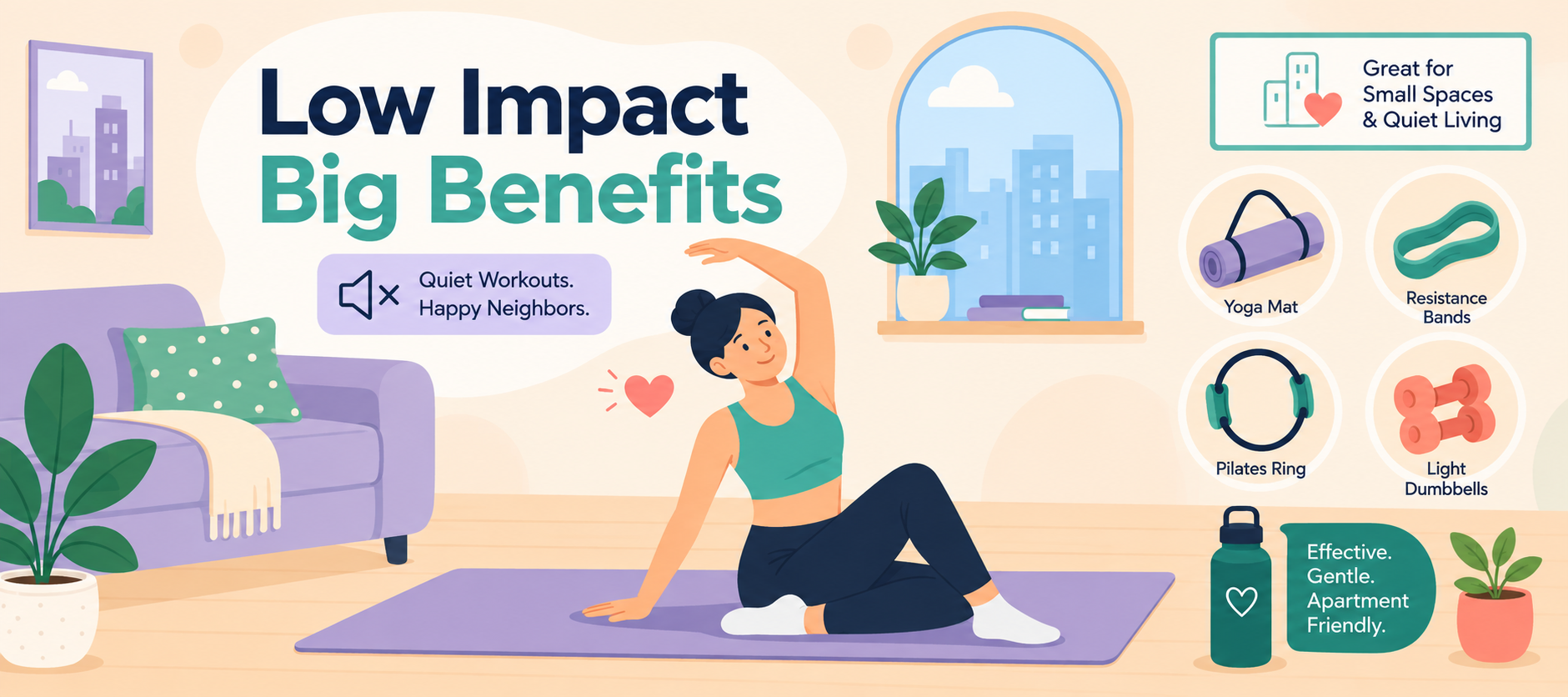
Combined with a yoga mat and a few resistance bands, this setup costs under $100 and stores completely flat. For someone in a very small studio, it's a workable primary setup while saving up for a machine.
Comparing your options by space, noise, and budget
Before buying anything, it helps to see the key variables side by side rather than flipping between product pages. The table below pulls from real footprint measurements and tested noise data, not just spec sheets. Values marked as approximate reflect the range typically found across common models in each category.
| Machine | Approx. footprint | Noise level | Joint friendliness | Price range |
|---|---|---|---|---|
| Under-desk elliptical | ~19 x 14 in | Very quiet (12, 38 dB) | Good | $80, $300 |
| Mini stepper | ~12 x 14 in | Quiet (20, 30 dB) | Moderate | $30, $150 |
| Folding upright bike | ~36 x 18 in folded | Very quiet | Good | $200, $600 |
| Recumbent bike | ~55, 60 x 24 in | Quiet | Best | $300, $1,000 |
| Compact rowing machine | ~55 x 22 in | Moderate | Good (with mobility) | $250, $900 |
| Resistance bands + mat | Fits in a bag | Silent | Excellent | $20, $100 |
Calorie burn reality check: rowing machines burn the most at 560 to 900 kcal per hour at vigorous effort, followed by ellipticals at 280 to 450 kcal, then bikes.
But intensity is the bigger variable.
A hard effort on a recumbent bike outruns a casual row every time, so don't rule out a machine based on these numbers alone.
Factor in which machine you'll actually push yourself on.
Setting up a low-impact routine in a small space
Buying the equipment is the easy part. Making it fit into a real apartment and a real schedule takes deliberate planning, especially when floor space doubles as living space for the other 23 hours of the day.
Space planning before you order
Measure your available floor area before you choose a machine category. A recumbent bike needs about 5 feet of clear length and 2 feet of width, plus some clearance around it. A mini stepper needs less than 2 square feet of floor space.
As a rough guideline, if your open area is under about 40 square feet, focus on under-desk models or band-and-slider setups rather than trying to squeeze in a full machine.
Rolling storage casters and foldable frames make a significant difference in day-to-day usability, especially in studio apartments where the workout space and the living room are the same room.
A sample 20-minute apartment-friendly workout
A practical starting routine uses two pieces: a folding bike and a resistance band kit.
Cycle at moderate resistance for 10 minutes, then move through three resistance band exercises (rows, banded hip hinges, and lateral band walks) for two rounds of 8 to 10 reps each.
Return to the bike for a final 5-minute cooldown. On a magnetic folding bike paired with band work, the whole session stays well under 60 dB, fits in a 6 x 6 foot area, and covers both cardio and basic strength in 20 minutes flat.
How to pick the right low impact workout equipment
The number of options in this category makes it easy to overthink the decision. Three questions narrow it down quickly, and they work better than any "best of" list because they filter by your actual constraints rather than someone else's priorities.
Three questions to answer before buying
- How much clear floor space do you have when you move the coffee table? This determines whether you're shopping for a full machine or a compact/no-machine option.
- Does your building have quiet hours or thin floors that rule out louder machines? If yes, magnetic resistance is non-negotiable.
- Is the primary user dealing with a specific joint condition that requires a recumbent position over a standing one? If yes, the recumbent bike category jumps to the top of the list.
The answers point you to a machine category before you ever look at a specific model, and narrowing the category first saves you from comparing machines that don't fit your situation.
Where CompactFitZone's reviews make the final call easier
Narrowing to a category is the starting point, but picking the right model within that category requires noise-test data and real dimension measurements, not just spec sheets.
CompactFitZone publishes in-depth reviews with decibel readings, side-by-side footprint comparisons taken in real apartment rooms, and a curated shortlist of best buys across budget, mid-range, and premium tiers.
If you want to skip the research and go straight to tested recommendations, the CompactFitZone selected items are built specifically for this decision and updated for 2026 pricing.
Low impact workout equipment: the bottom line
The best gentle workout equipment is the one that matches your specific constraints. For seniors and post-surgery recovery, a recumbent bike offers the most joint protection available in a home setting.
For most apartment dwellers, a folding bike or under-desk elliptical hits the practical sweet spot on noise, footprint, and cost.
Resistance bands round out any setup by covering strength movements no cardio machine replicates, at minimal cost and zero noise.
Start with the comparison table in this guide, work through the three buying questions, and you'll have a clear category before you spend a dollar.
For tested model picks across every category and budget, CompactFitZone has the shortlists ready. Choose low impact workout equipment that matches your space, your noise limits, and your body's current recovery needs, and you'll get consistent use out of it.

Comments (0)
Post a comment